“Pulling off the plug” does not mean shutting data down
Individual countries do not need to own the world’s AI giants to shape the future of artificial intelligence or super intelligence. But they do need the power to decide how, and on whose terms, their strategically valuable data, enters the global AI value chain.
What happens when AI begins to run short of the data it needs most? In December 2025, the World Economic Forum argued that AI is consuming novel and useful training data faster than such data is being generated—even as the total volume of global data continues to soar. As high-quality, context-rich data becomes scarcer, the datasets generated within countries could become far more strategically valuable.
Yet the global AI governance debate is still largely shaped by two superpowers and a small circle of technology companies. The United Nations is widening participation, but the real test is not simply whether individual countries have a seat at the able. It is whether they arrive as individual rule-takers—or with collective assets and bargaining power.
Data could be one of those assets on the AI governance table.
National datasets are already powering the AI economy
For decades, participation of countries in international negotiations has depended heavily on diplomatic representation. Diplomacy remains vital but coordinated efforts would put something tangible behind it.
Individual sovereign states are not standing outside the AI revolution. Their agricultural records, soil and climate observations, field boundaries, national languages, health information, mobility patterns, business transactions, satellite imagery, public records and scientific measurements are already helping to make AI systems more capable.
But producing valuable data is not the same as capturing its value. For much of the digital era, the countries generating the underlying economic and social activity have had little influence over what happens further along the value chain. AI raises the stakes: technical infrastructure and ownership of advanced intelligence are increasingly concentrated in very few hands.
Individual countries could enter the room and be able to say:
We, each, represent interoperable data ecosystems covering hundreds of millions of people, multiple languages, environments, agricultural systems and markets, and access to strategically governed datasets should take place on agreed terms.
That changes the posture entirely. The conversation moves from “Please include us in AI governance” to “Global AI governance requires agreement with individual countries.”
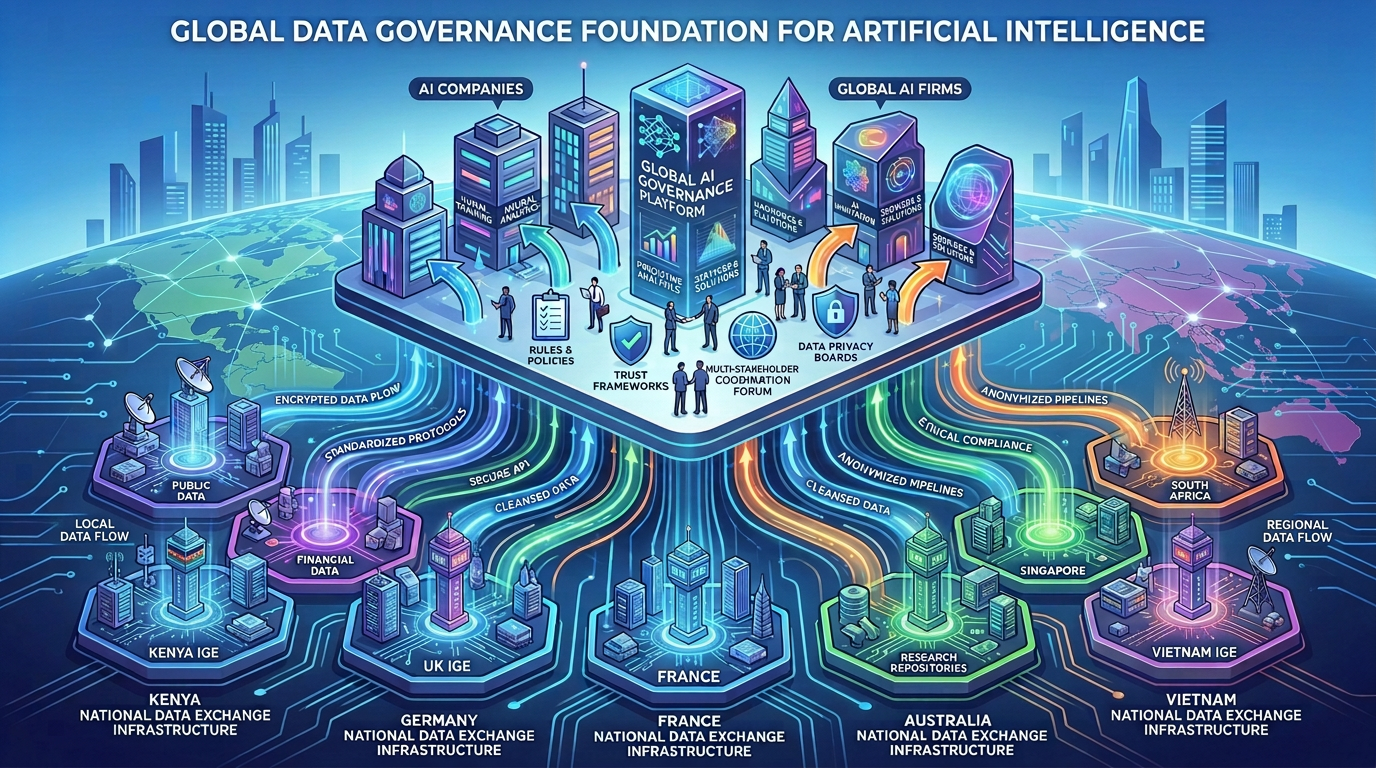
A coordinated regional, sub-regional, and continental positions, backed by federated national data infrastructure, would allow data governance to evolve from simply controlling data to governing access to data as strategic national asset.
If individual countries generate strategically valuable data, why should their role be limited to supplying data, consuming models and accepting rules designed elsewhere?
The challenge for countries, then, is not simply to generate more data to feed Ai models. It is to build the institutional and technical capacity to decide when access is granted, to whom, for what purpose, under which safeguards, and what value must flow back.
“Pulling off the plug” does not mean shutting data down
Strategic data sovereignty is not about locking data behind national borders. It is about giving sovereign states and institutions the ability to determine how strategically important data is accessed, transferred, combined, monetised and used.
The negotiating position is not “no access”. It is Yes, subject to our terms.
Critics may argue that the horse has already bolted: much of the world’s accessible data has been copied and used to train existing AI models, and withdrawing the original datasets will not make those models forget what they have learned. That criticism is valid but incomplete. AI development is not a one-time act of training. Models must be updated, localised, evaluated and connected to fresh, authoritative data. Countries’ future leverage therefore lies not in attempting to reclaim every dataset already absorbed, but in governing access to the continuous flows of high-quality data that future AI systems will need.
Scale changes the equation
A single member state of a bloc negotiating with a hyperscale or frontier AI company may have limited leverage. But interoperable national data exchange infrastructures could connect trusted national systems into regional and continental data spaces that transform fragmented assets into collective influence.
Imagine the progression for example in Africa: 54 national data exchange infrastructures, connected through subregional arrangements in ECOWAS, the EAC, SADC, COMESA and other communities, and ultimately linked through an African Data Exchange Infrastructure participating in the global AI ecosystem. Each country would retain authority over its national data governance while adopting common rules for trusted cross-border exchange: federation without surrendering sovereignty.
At its heart is a broader principle: every sovereign country whose people, institutions, environments and economies generate data that feeds AI, should have its contribution recognised and its voice respected. Sovereign states should not be treated merely as passive sources of raw data while a small number of governments and companies determine the rules and what they should receive as benefits. They should have a meaningful place in the global discourse that decides what data feeds these systems, under what conditions it is used, whose values shape the resulting intelligence and how the benefits are shared.
Sovereignty must protect rights, not expand state ownership
The answer is not digital statism either. There is an important line that must not be crossed – “countries owning their data” cannot mean governments claiming ownership of every dataset. Data generated by citizens, communities and private enterprises remains subject to personal rights, privacy, intellectual property, commercial confidentiality, indigenous and community interests, and sector-specific rules.
The goal is to establish trusted institutions through which rights holders, data custodians, businesses, researchers and governments can exercise appropriate control over access and use.
Conclusion
Data is one strategic asset over which countries can realistically gain much greater agency, and they do not need to wait for permission to begin. National Data Exchange Infrastructure (NDEI) can bridge that gap by providing the technical and institutional execution layer. NDEI offers a practical way to turn data from something merely generated within national borders into governed, interoperable and negotiable asset. This is not about one country dramatically “pulling off the plug”. It will come from something more durable: coordinated rules, trusted institutions and interoperable systems that allow regional blocs to decide when the plug is connected, who benefits and on whose terms. A bottom-up approach to complement the current top-down model.


